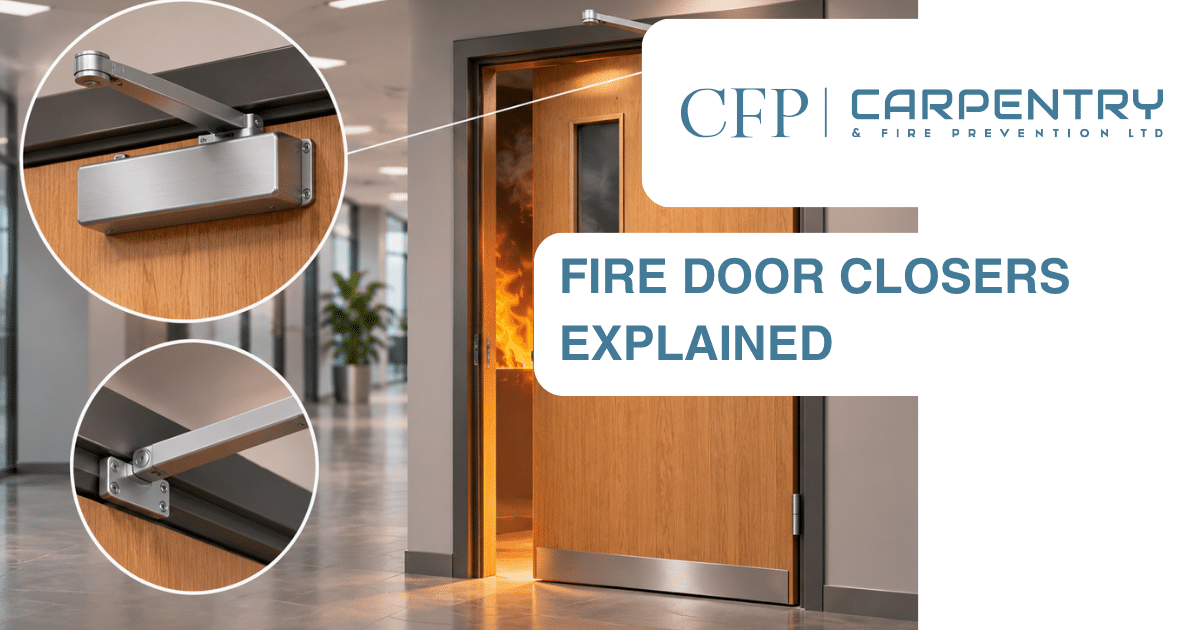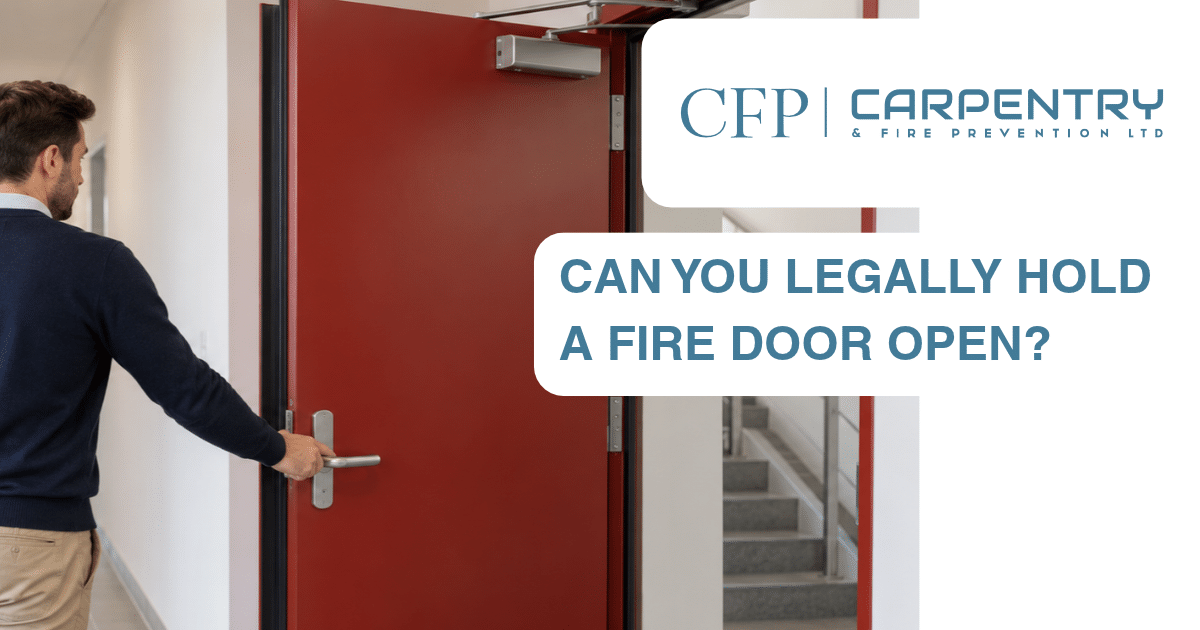


A fire door that is standing open is not a fire door. It is a hole in a wall. That single sentence explains why self-closing devices exist, and why fire risk assessors, inspectors and enforcing authorities take them so seriously.
The question of whether every fire door needs one comes up constantly, usually because a closer is making a door awkward to use and somebody wants to know if it can come off. In this guide, we will explain where the rules demand self-closers, the standards that govern them, the legitimate ways to hold a fire door open, why removing a closer causes such a serious problem, and how inspectors assess them.
Why Self-Closers Exist
Fire doors only work when closed. Compartmentation depends on the barrier being complete, and a door left ajar allows fire and, far more quickly, smoke to move into escape routes.
Relying on people to close doors behind them does not work. In normal use doors get left open for convenience, and in an emergency people leave in a hurry and do not stop to shut anything behind them. The self-closing device removes the human factor entirely, which is precisely the point.
The effect of getting this wrong is not subtle. A single open door on a stairwell can render the only escape route in a building unusable within minutes, and can allow smoke to travel upwards through the building far faster than the fire itself spreads.
Where Self-Closers Are Required
The requirement comes from a combination of building regulations guidance and the building’s own fire risk assessment rather than from one line of statute.
In blocks of flats, flat entrance doors opening onto communal escape routes normally need a self-closing device, and so do the communal fire doors themselves: doors onto stairwells, cross corridor doors, lobby doors, and doors to plant rooms, bin stores, risers and service cupboards.
In commercial and other non domestic premises, fire doors protecting escape routes and separating compartments need to close themselves. That covers stairwell doors, corridor doors, and doors to higher risk areas such as plant rooms, kitchens and storage.
In houses in multiple occupation, licensing conditions commonly require self-closing devices on bedroom doors and on doors opening onto escape routes, and the local authority will usually specify this directly.
The consistent principle across all of them is that a fire door forming part of the compartmentation or protecting an escape route needs to close itself. A door that stays permanently locked shut, such as a service cupboard, may not need a closer at all, and will normally carry a Fire Door Keep Locked sign instead.
What the Regulations Say About Tampering
Regulation 10 of the Fire Safety (England) Regulations 2022 does not simply assume self-closers are present. It requires responsible persons in blocks of flats with common parts to tell residents to keep fire doors shut when not in use, to leave self-closing devices alone, and to report any fault or damage immediately.
That duty applies to every block of flats with common parts regardless of height. You must give new residents the information as soon as reasonably practicable, and remind everyone at least every twelve months.
The fact that the regulations single out tampering tells you how common it is. Removing or disabling a closer is one of the most frequent fire door defects found anywhere in the UK building stock.

The Standards Behind the Hardware
Two European standards do most of the work here, and you will see them referenced on inspection reports and product datasheets.
BS EN 1154 covers controlled door closing devices. The standard grades closers by power size, and the size has to suit the door. A closer set too weak will not overcome the latch and the seals reliably, particularly from a small opening angle, while one set too strong makes the door difficult to open and invites people to prop it.
BS EN 1155 covers electrically powered hold open devices for swing doors. These are the products that legitimately allow a fire door to stand open, because they release the door on activation of the fire alarm or on loss of power.
Closers also need to be compatible with the doorset’s fire test evidence. Fitting a closer that was not part of the tested assembly can undermine certification even where the closer itself is a perfectly good product.
There is an accessibility dimension too. Approved Document M deals with access to and use of buildings, and closing forces that are safe from a fire perspective can be difficult for some users to manage. Free swing closers and hold open devices are often the answer, since they allow easy movement in normal use while still closing the door on alarm.
Holding Fire Doors Open Legitimately
There are perfectly good reasons to want a fire door open: moving equipment, ventilation, accessibility, or simply heavy traffic through a corridor. Wedges, extinguishers, chairs and hooks are not the way to achieve it.
The legitimate options all share one characteristic, which is that the door closes automatically when the alarm sounds.
Electromagnetic hold open devices wire into the fire alarm system and release the door the moment it activates or the power fails. Free swing door closers allow a door to move freely, as though it had no closer at all, until the alarm sounds, at which point it reverts to normal closing action. Acoustic door retainers listen for the sound of the alarm and release the door in response, which makes them useful for retrofitting where wiring is impractical.
All of these need the same maintenance and testing as any other fire safety measure, and an inspector will check that they actually release as intended.
Why Removing a Closer Is Such a Serious Problem
Closers get removed because doors slam, because they are stiff, because a resident finds them awkward, or because somebody wants the door to stay open. The reasoning is understandable and the consequence is not proportionate to it.
A flat entrance door without a working closer means that if a fire starts in that flat and the occupants leave, as people naturally do, the door stands open and the fire vents directly into the communal stairway. The building’s stay put strategy, which depends on the fire staying inside the flat, no longer holds.
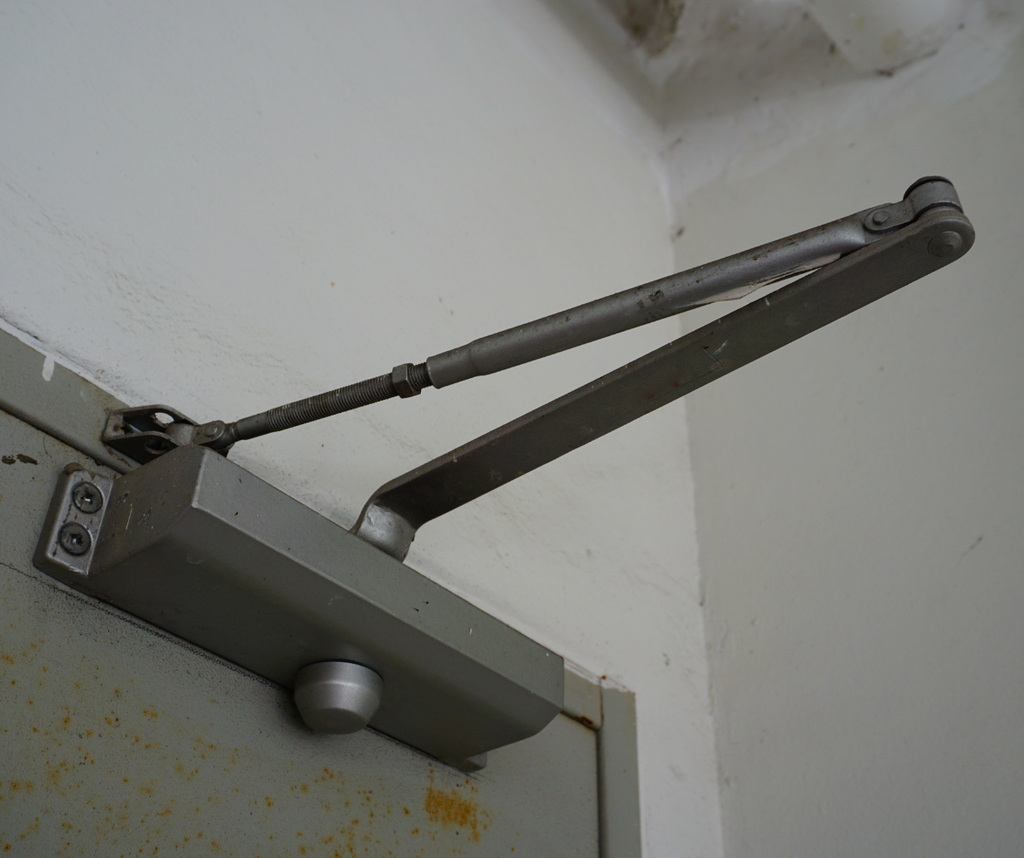
If the closer is genuinely a problem, the fix is adjustment or a different device rather than removal. An installer can usually adjust a slamming closer for closing speed and latch action. A closer that feels too heavy may simply be the wrong power size for the door. A door that needs to stand open needs a hold open device, not a wedge.
How Closers Are Assessed During Inspection
An inspector will test the closer from multiple opening angles, including a very small one, and confirm the door closes fully and the latch engages every time. Closing from ninety degrees but stalling near the frame is a failure.
They will check the device’s specification and adjustment against the door, look for hydraulic fluid leaks, bent or damaged arms and loose fixings, and confirm that the right fixings hold it into the leaf and frame. Where a door carries a hold open device, they will verify that it releases and closes properly on alarm activation.
Closer defects appear on almost every survey we carry out, which is why they are also one of the main things to look at during routine checks between full inspections. If you want a documented position on the doors in your building, a fire door survey will assess every closer alongside the rest of the doorset.
Frequently Asked Questions
Do all fire doors need self-closers?
Almost all fire doors protecting escape routes or forming part of the compartmentation do. The main exception is a door kept permanently locked shut, such as a service cupboard, which will normally carry a Fire Door Keep Locked sign instead.
Is it illegal to remove a fire door closer?
Removing or disabling a self-closing device undermines a fire safety measure the law requires the responsible person to maintain, and in blocks of flats the regulations explicitly tell residents to leave them alone. It can lead to enforcement action against the responsible person.
Can a fire door be propped open legally?
Only using an approved device that releases the door automatically on fire alarm activation, such as an electromagnetic hold open device, a free swing closer or an acoustic retainer. Wedges and improvised props are never acceptable.
My fire door slams. Can it be adjusted?
Usually yes. Most overhead closers have adjustable closing speed and latch action, and a slamming door often just needs setting correctly rather than replacing.
Do flat entrance doors need self-closers?
Where the door opens onto a communal escape route, yes. It is the component that keeps a fire inside the flat where the building’s evacuation strategy assumes it will stay.
Need Help With Fire Door Closers?
At CFP Carpentry & Fire Prevention, we survey, adjust, replace and install fire door closers and hold-open devices as part of our fire door work for landlords, freeholders, managing agents and commercial building owners.
Get in touch today to discuss self-closers or to arrange a fire door survey.