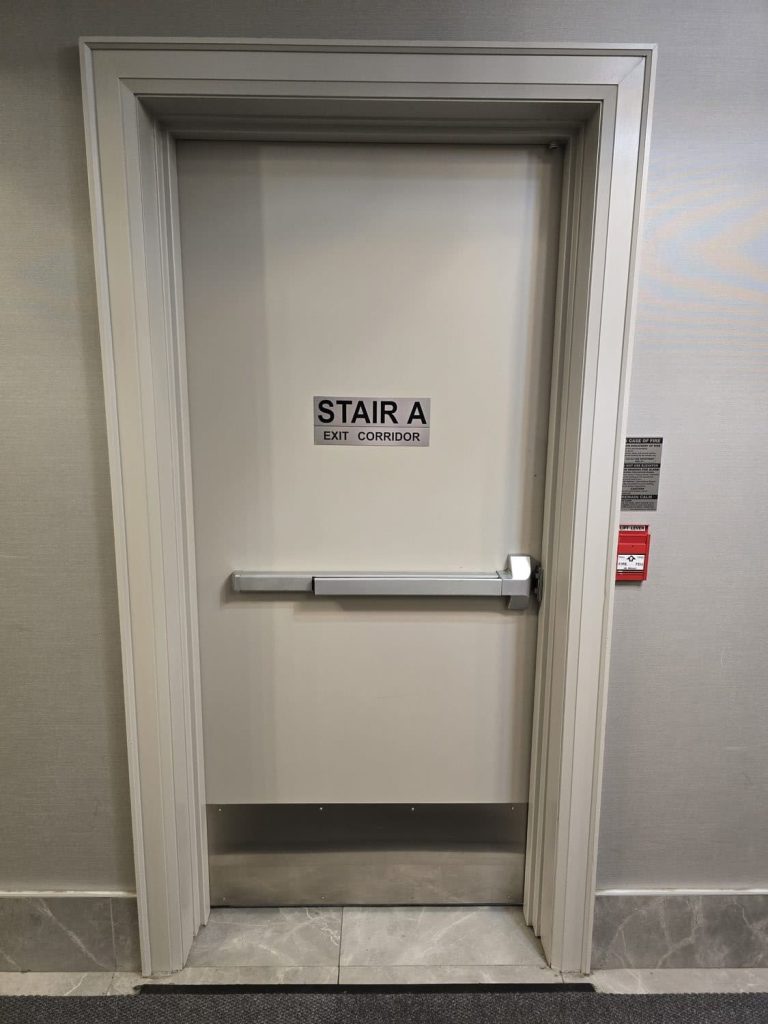
A closed grey metal fire door labelled STAIR A EXIT CORRIDOR with a push bar sits in a corridor with grey walls, a fire alarm mounted to the right.

Professional Metal Fire Door Supply, Installation & Compliance Services

At CFP – Carpentry & Fire Prevention, we specialise in the supply and installation of high-quality metal fire doors for commercial, industrial and residential buildings across the South, South West, London, South East and wider UK. Whether you need a single metal fire door or a double metal fire door assembly, we deliver expertly installed, certified fire doors that meet your building’s safety requirements and legal compliance.

Metal fire doors are robust, reliable and ideal for high-traffic and high-risk areas where fire safety, durability and longevity are vital.

Areas We Cover

For national programmes, multi-site contracts or larger projects outside these areas, contact us to discuss coverage.

What Are Metal Fire Doors?

Metal fire doors are fire-resistant doors constructed predominantly from steel or other metal materials certified to resist fire for a specified period. Depending on the rating, they can block the spread of fire and smoke for 30 minutes (FD30) through to 120 minutes (FD120) or more when tested and certified. (states common rating standards).

Metal fire doors sets — including the frame, door leaf, seals and hardware — are tested together in controlled fire tests and classified according to British Standards and European product standards.

Single Metal Fire Doors

A single metal fire door is one leaf (panel) that provides a fire-resistant barrier. These are commonly used in corridors, stairwells, plant rooms, service risers and for compartmentation where a single access point is required.

Double Metal Fire Doors

A double metal fire door assembly consists of two leaves that meet in the centre. Double fire doors are ideal for larger openings, high traffic areas and commercial spaces such as warehouses, loading bays, auditorium exits and industrial environments. 

Double fire doors must be accurately installed — with correct gaps, intumescent seals and certified hardware — to maintain their fire resistance performance.

A white metal fire door with a push bar and a vertical window has a sign reading “To Reception.” Above the door is a red “EXIT” sign. The walls are white, and the floor is wood-patterned vinyl.

Types of Metal Fire Doors

We install a variety of metal fire doors based on your building’s needs:

• Steel Fire Doors – The most common metal fire doors with strong fire resistance and durability. Often used where robustness is critical (commercial, industrial, high-traffic). 

• Galvanised Steel Fire Doors – Provide corrosion resistance for external or damp environments.

• Glazed Metal Fire Doors – Metal fire doors with fire-rated glass panels for corridors and areas requiring light while still maintaining fire integrity (glass must be fire-rated). 

• External Metal Fire Doors – Designed for building exits that need to resist fire and weather, often CE/UKCA marked under EN standards.

Each product is supplied with the correct fire-rated frame, intumescent seals, self-closers and certified hardware in line with its fire resistance rating.

A yellow plastic shim is wedged between two closed doors labelled with blue signs reading Fire door keep locked. The tool appears to be inserted to open or manipulate the doors.

Why Use a Metal Fire Door vs Timber?

Metal fire doors offer key advantages:

Higher fire resistance potential

Metal doors can be engineered with higher ratings (e.g., up to FD120 or beyond) compared with many timber options. 

Durability & strength

Metal resists impact, wear and heavy usage better than many timber doors.

Low maintenance

Metal is less prone to warping, rot or moisture damage over time.

Security & hygiene

Ideal for high-security or high-cleanliness locations such as hospitals, kitchens, laboratories and industrial sites. 

While timber fire doors are suitable in many buildings, metal fire doors are favoured where strength, longevity and maximum fire resistance are priorities.

Where Metal Fire Doors Are Typically Installed

Metal fire doors are commonly installed in:

• Commercial buildings — offices, retail, factories
• Industrial properties — warehouses, workshops
• Plant rooms and service risers
• Escape routes and stairwells
• Loading docks and high-traffic exits
• Healthcare and educational facilities
• Residential blocks (communal areas) GOV.UK

They are often required wherever buildings are compartmentalised to protect escape routes or separate high-risk areas.

Laws & Regulations on Metal Fire Doors (UK)

Metal fire door installation and use are governed by UK fire safety law and building regulations:

Approved Document B – Fire Safety (Building Regulations)

This document sets out where fire doors are required in buildings, how long they must resist fire (fire resistance rating) and how they contribute to compartmentation and safe escape routes.

Regulatory Reform (Fire Safety) Order 2005

Under the Fire Safety (England) Regulations 2022, Responsible Persons must ensure fire safety measures — including fire doors — are suitable, maintained and regularly inspected. Fire doors must be kept operational and compliant with the fire risk assessment.

Standards & Testing

Fire doors are tested to standards like BS 476 Part 22 and BS EN 1634-1 to achieve a fire resistance rating (e.g., FD30, FD60, FD90, FD120). All components (door leaf, frame, seals and hardware) must be certified as part of the fire door set for compliance.

Installation & Compliance

Fire doors must be installed with correct gaps, intumescent and smoke seals, self-closing devices and certified hardware to ensure they perform as tested. Improper installation can void certification.

What Our Metal Fire Door Installation Includes

• Site survey & specification
• Supply of certified metal fire doors (single & double)
• Fire-rated frame and certified hardware
• Intumescent seals & self-closing mechanisms
• Professional installation by trained engineers
• Certification documentation for building control & compliance
• Final inspection & handover

We handle both new installations and replacements to ensure your building meets legal requirements and safety standards.

A hand is operating a stainless steel push bar on white metal fire doors, clearly showing the mechanism of a door lock.
Two closed blue metal fire doors on a white wall; the larger door has a panic bar, and the smaller door has a standard handle. A small fire extinguisher sign is mounted between them above the floor’s shiny surface.
A black van with CFP Carpentry branding and contact details on the back is parked on a street. The van has a number plate reading N3 CFP and is framed by trees and a building in the background.

Frequently Asked Questions

A metal fire door is a fire-resistant door made primarily from steel or other metals. It is designed to prevent the spread of fire and smoke for a specified period (e.g., FD30, FD60, FD90, FD120) and is used where high durability and fire performance are required.

A single metal fire door has one door leaf and is used for standard openings. A double metal fire door has two leaves that meet in the centre, providing a wider opening for larger entrances or areas with frequent traffic.

Metal fire doors are commonly installed in commercial buildings (offices, factories, retail), industrial sites (warehouses, workshops), plant rooms, corridors, stairwells, loading bays, and communal escape routes in residential blocks. They are ideal wherever strong fire resistance and durability are required.

Metal fire doors can be supplied with different fire resistance ratings such as FD30, FD60, FD90 and FD120 or higher, depending on the project requirements and building regulations.

Metal fire doors offer several advantages:
• Higher potential fire resistance ratings
• Greater durability and impact resistance
• Better moisture and warping resistance
• Low maintenance and long-lasting performance
• Ideal for high-traffic or industrial environments

Yes. Metal fire doors can include fire-rated glazed panels where light and visibility are needed, provided the glass and frames are tested and certified to the same fire resistance standard as the door.

Yes. To maintain performance, metal fire doors must be fitted with certified fire-rated hardware such as intumescent seals, self-closing devices, fire-rated hinges and appropriate locks.

Metal fire doors must comply with UK Building Regulations (Approved Document B – Fire Safety) and fire safety legislation, including the Regulatory Reform (Fire Safety) Order. They must be installed in accordance with manufacturer instructions and tested as complete assemblies to maintain their fire resistance rating.

Fire doors must be installed correctly to perform as designed. Improper installation can compromise fire resistance and void certification. For safety and compliance, metal fire doors should be installed by trained professionals.

Fire doors should be regularly checked as part of building fire safety maintenance. Best practice is a visual inspection at least every six months, with formal inspections carried out annually or as recommended in a fire risk assessment.

Yes. While metal fire doors are low-maintenance compared with timber, they still need regular checks to ensure seals, closers and hinges work properly and are not damaged.

Contact us with your project details, door size and location requirements. We will arrange a survey if needed and provide a clear, tailored quote for your metal fire door installation.