

If you manage a commercial building, you may expect the law to give you a simple answer such as every three months, six months or once a year.
It does not.
Unlike blocks of flats above 11 metres, commercial premises do not follow one fixed statutory inspection interval for fire doors. Instead, the law requires you to maintain them properly and choose an inspection schedule that suits the building, its occupants and the level of use.
For many commercial buildings, six-monthly professional inspections provide a sensible starting point, supported by more frequent visual checks. Higher-risk or heavily used buildings may need inspections every three months or even more often.
In this guide, we explain what the law actually requires, how often you should inspect fire doors in different types of commercial buildings, what factors should shorten the interval and what records you need to keep.
What Does the Law Require?
The Regulatory Reform (Fire Safety) Order 2005 applies to almost all non-domestic premises in England and Wales, including offices, shops, warehouses, factories, hotels, schools, hospitals, care homes, restaurants and leisure facilities.
Article 17 requires the responsible person to maintain fire safety measures, including fire doors, in efficient working order and good repair.
The law does not say that you must inspect every fire door every six months. Instead, it requires you to put a suitable maintenance system in place.
That means you need to choose an inspection frequency that you can justify.
Your fire risk assessment should guide that decision. It should consider how many fire doors the building contains, where they sit, how often people use them, the type of occupants in the building and the role each door plays in the fire strategy.
From there, you can build an inspection and maintenance schedule that reflects the actual level of risk.
How Often Should Commercial Fire Doors Be Inspected?
Although the law does not set one fixed interval, most commercial buildings should consider a detailed fire door inspection around every six months.
For quieter, lower-risk premises with limited footfall, an annual professional inspection may provide a reasonable minimum.
Buildings with heavy traffic, vulnerable occupants or a history of fire door defects may need inspections every three months.
You should also carry out routine visual checks between professional inspections. Many businesses complete these weekly or monthly as part of their normal facilities or fire safety checks.
These basic checks should confirm that the doors close and latch correctly, nobody has wedged them open, the seals appear intact, the hardware looks secure and nothing blocks the door’s movement.
Professional inspections then look much deeper at certification, measurements, components and installation quality.
Offices Fire Doors
For most offices with moderate levels of traffic, six-monthly professional inspections alongside monthly visual checks provide a sensible starting point.
However, you should pay closer attention to fire doors in busy corridors, stairwells, kitchens and heavily used communal areas.
A door that opens hundreds of times every day will usually develop problems faster than one protecting a rarely used storage room.
Schools and Colleges Fire Doors
Schools place much greater demand on fire doors.
High footfall, frequent use and the tendency for people to prop doors open can quickly cause problems with closers, hinges and seals.
Quarterly professional inspections make sense for many educational buildings, supported by frequent visual checks during term time.
Staff should also report doors that slam, fail to close or become difficult to operate rather than waiting for the next scheduled inspection.
Hospitals and Care Homes Fire Doors
Hospitals and care homes need particularly careful fire door management because many occupants cannot evacuate quickly without assistance.
Doors also experience constant movement from staff, patients, beds, wheelchairs and equipment.
Quarterly inspections provide a sensible baseline in many healthcare environments, with regular checks between them.
Where the building uses electromagnetic hold-open devices or free-swing closers, staff should also test them regularly to make sure they release correctly when the alarm activates.
Hotels and Guest Accommodation Fire Doors
Hotels combine regular door use with another important risk factor: sleeping occupants who may not know the building layout.
Bedroom doors, corridor doors and stairwell doors therefore need close attention.
Six-monthly inspections may suit some hotels, while busier properties may benefit from quarterly inspections.
Routine checks should also form part of normal hotel maintenance because guests, housekeeping staff and deliveries can quickly create everyday defects.
Retail and Hospitality Premises Fire Doors
Shops, restaurants, pubs and other hospitality venues often experience high public footfall, deliveries and frequent movement between different areas of the building.
Staff may also prop doors open during busy periods, which creates a common compliance issue.
Quarterly professional inspections often make sense in busy premises, supported by regular visual checks.
Managers should pay particular attention to kitchen doors, stock room doors, stairwells and doors protecting escape routes.
Warehouses and Industrial Buildings Fire Doors
Warehouses may have fewer fire doors than offices or hotels, but the doors often suffer much harder use.
Trolleys, pallet trucks, forklifts and moving equipment can damage leaves, frames, closers and surrounding fire stopping.
A six-monthly inspection may suit a lower-traffic site, while buildings that regularly suffer impact damage may need quarterly checks or more frequent targeted inspections.
The damage history should guide the interval.
Gyms and Leisure Centres Fire Doors
Gyms, sports centres and leisure facilities combine high occupancy with frequent movement of equipment.
Staff may also prop doors open for ventilation or easier access, which can damage closers and defeat the purpose of the fire door.
For busy leisure environments, quarterly inspections provide a sensible starting point, supported by frequent visual checks.
Humidity can also affect timber doors in swimming pools, changing rooms and similar areas, so these environments may require closer monitoring.
What Should Make You Inspect Fire Doors More Often?
Your inspection schedule should never stay fixed simply because you have always followed it.
Several factors should make you shorten the interval.
High Usage Fire Doors
The more often people use a door, the faster its hinges, closer, seals and fixings experience wear.
Doors in main corridors, stairwells, entrances and busy circulation routes usually need more attention than doors in quieter areas.
Previous Failures Fire Doors
If your last inspection found several defects, do not simply wait another year and hope the situation improves.
Shorten the next inspection interval until the condition of the doors stabilises.
Repeated failures usually signal either heavy use, poor maintenance, unsuitable components or recurring behaviour such as wedging doors open.
Vulnerable Occupants
Buildings that accommodate people who may struggle to evacuate quickly should take a more cautious approach.
Hospitals, care homes and some educational settings fall into this category.
The consequences of a fire door failing in these buildings can be greater, so the inspection programme should reflect that risk.
Building and Refurbishment Work
Contractors regularly disturb fire doors, frames and fire stopping during unrelated building work.
Even a small refurbishment can change gaps, loosen hardware or damage surrounding fire stopping.
Inspect affected doors after significant work instead of waiting for the next routine inspection.
Environmental Conditions
Humidity, temperature changes and exposure to weather can change the way timber doors sit within their frames.
Swimming pools, changing rooms, kitchens and external locations can therefore require more frequent attention.
Routine Checks and Professional Fire Doors Inspections Are Not the Same
You need both.
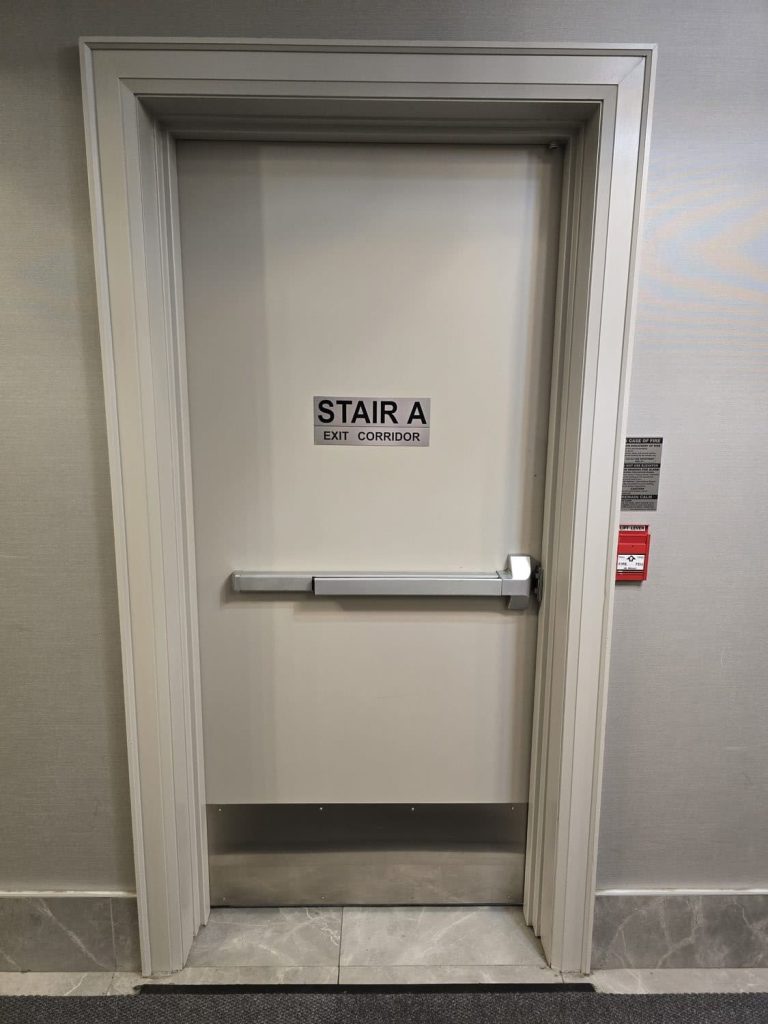
Routine checks provide a quick visual confirmation that the door still works as expected. A trained facilities manager, caretaker or nominated member of staff can usually carry them out.
They should check that the door closes and latches, nobody has wedged it open, the seals look intact, the hinges appear secure and no obvious damage affects the leaf or frame.
A professional inspection goes much further.
A trained fire door inspector measures gaps with gauges, checks certification against test evidence, assesses hinge and hardware compatibility, tests the closer from different opening angles, examines the frame fixings and checks the surrounding fire stopping.
The inspector should then provide a door-by-door report that identifies defects, prioritises risk and recommends remedial action.
Routine checks catch the day-to-day problems. A professional fire door survey finds technical defects that a quick visual check may never reveal.
What Fire Doors Records Should You Keep?
Your records help you demonstrate that you actively manage your fire doors rather than simply assuming they remain compliant.
Record the date of every check and inspection, who carried it out and which doors they examined. Identify each door individually rather than recording a general building-wide pass.
If you find a defect, record what you found, what action you took and when you completed the repair.
Keep professional inspection reports together with evidence that you completed the recommended remedial work.
Fire and rescue authorities may ask to see these records during an inspection or investigation. Good documentation shows that you identified issues and acted on them.
Poor records make it much harder to demonstrate that you have maintained an effective fire safety system.
What Happens If You Do Not Inspect or Maintain Fire Doors?
Fire and rescue authorities enforce the Fire Safety Order.
If they find poorly maintained fire doors, they can require you to complete remedial work through an enforcement notice.
If the condition of the doors creates a serious risk, they can also restrict the use of part or all of the building through a prohibition notice.
Serious breaches can lead to unlimited fines and, in the most severe cases, prosecution.
Insurers may also ask for inspection and maintenance records after a fire. A documented maintenance programme gives you clear evidence of what you knew, what you checked and what action you took.
Fire Doors Frequently Asked Questions
Is there a legal requirement to inspect commercial fire doors every six months?
No. The law does not set a six-month inspection interval for commercial premises. Six-monthly inspections reflect common industry practice rather than a fixed statutory requirement.
Your fire risk assessment should determine the inspection frequency based on the building and the level of risk.
How often should fire doors be checked in a busy building?
High-traffic buildings may benefit from professional inspections every three months, supported by weekly or monthly visual checks.
Schools, hospitals, hotels, retail premises and leisure facilities often fall into this category.
Who can check fire doors?
A trained and competent member of staff can carry out routine visual checks.
A detailed professional inspection should involve someone with recognised fire door inspection training who can assess certification, measurements, hardware and installation quality.
Do fire doors expire?
No. Fire doors do not have a fixed expiry date.
A properly installed and maintained fire door can remain suitable for many years. Poor maintenance, damage or unauthorised alterations can cause a much newer door to fail.
Condition matters more than age.
What should we do if nobody has inspected our fire doors before?
Start with a full professional survey.
That gives you a clear baseline for every door in the building. You can then repair any defects, set an inspection frequency based on the findings and your fire risk assessment, and start keeping proper records.
Need a Fire Door Inspection Programme?
At CFP Carpentry & Fire Prevention, we help commercial building owners, facilities managers and managing agents establish practical fire door inspection and maintenance programmes. We can carry out an initial fire door survey, identify and prioritise defects, complete remedial works, install certified fire doors where replacement becomes necessary and provide documented reports for your compliance records.
We work across Bournemouth, Southampton, Poole, Exeter and Plymouth in the South and South West; London, Guildford, Slough and Croydon across London and the South East; and Bristol, Swindon and Oxford across the Midlands and wider areas.
If you want to establish the right inspection schedule for your premises, get in touch to arrange a professional fire door survey and build a maintenance programme around the actual condition and use of your doors.