

Most fire door closer problems are adjustment problems wearing the costume of a fault. A door slams hard enough to crack plaster and somebody orders a replacement closer. A door stops an inch short of the frame and somebody books a new doorset. In both cases a competent joiner with a screwdriver and ten minutes would have fixed it, because the closer was never broken. It was set wrong, or it was the wrong power size for the door from the day it was fitted.
In this guide we will explain the types of closer you will encounter. We cover what the BS EN 1154 classification on the box actually tells you, and which adjustments a closer offers. We also look at how to diagnose common faults, and where adjustment stops being the answer.


What a Closer Has to Achieve
A closer has one job with two halves, and the second half is the one that gets missed.
It has to return the door from any open position to the frame. It then has to drive the latch home against the resistance of the intumescent strips and smoke seals. That second part is harder than it sounds. Seals compress, and a door approaching the frame meets increasing resistance in the final few degrees of travel, exactly where the closer has least mechanical advantage.
This is why inspectors test from a small opening angle rather than from ninety degrees. A door released from wide open builds momentum and will often latch on that alone. Released from a few degrees, it has to rely on the closer doing its job properly. A closer that manages the wide swing and stalls short of the latch from a narrow one has failed. The narrow angle matches how people actually leave doors.
The Types You Will Encounter
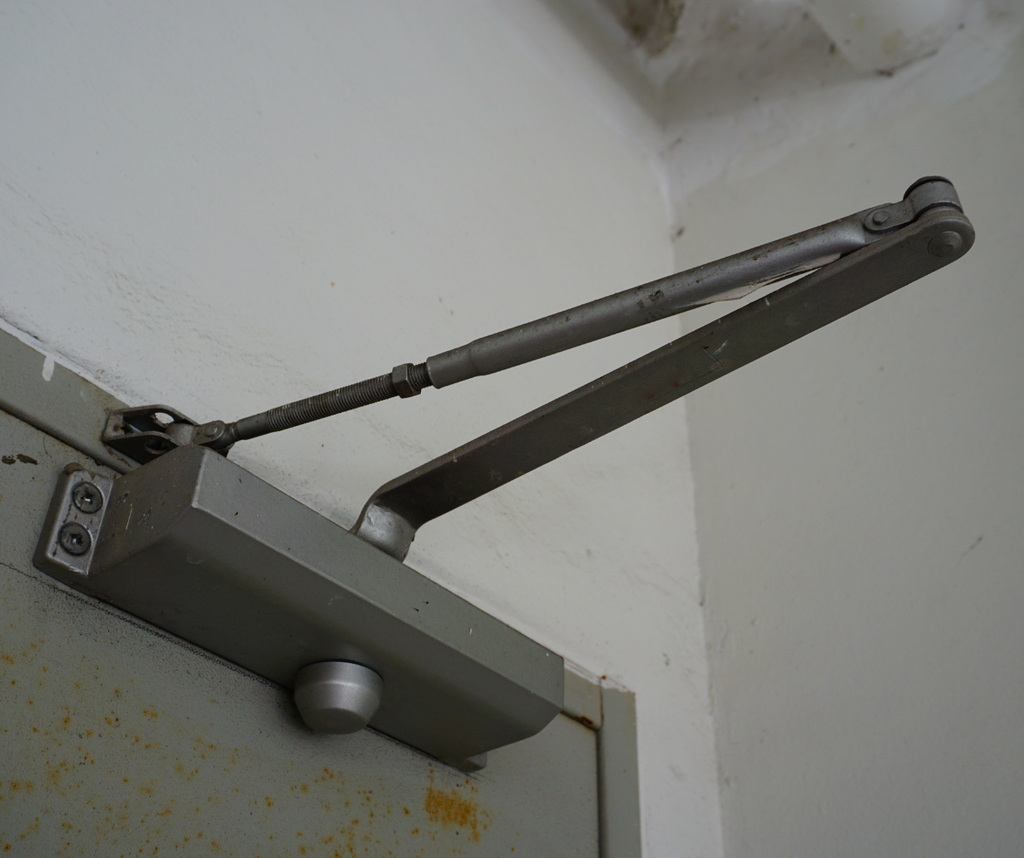
Overhead closers. The standard device, mounted on the face of the leaf with an arm to the frame, or on the frame with an arm to the leaf. Hydraulic, adjustable, serviceable, and visible. The overwhelming majority of fire doors carry one.
Concealed closers. Fitted into a mortice in the leaf and frame, invisible when the door is closed. Chosen for appearance, common on flat entrance doors where residents object to visible hardware. They offer fewer adjustments than overhead units, they are harder to service, and the mortice they need has to fall inside the doorset’s tested scope.
Floor springs. Mounted in the floor beneath the door, carrying the leaf as well as closing it. Used on heavy doors, double doors and glazed entrances. Durable, expensive, and disruptive to replace.
Free swing closers. These allow the door to move as though it had no closer at all during normal use. It reverts to conventional closing when the fire alarm activates or power fails. They solve the accessibility problem on doors where a conventional closing force is too much for some users.
Electromagnetic hold-open devices. Hold the door open and release it on alarm activation or power loss, covered by BS EN 1155 rather than BS EN 1154. These are the legitimate way to keep a fire door open.
Cam action closers. A variant of the overhead closer, using a cam and roller rather than a rack and pinion. It produces a lower opening force for the same closing power. Useful where accessibility matters and a free swing unit is not warranted.


Reading the BS EN 1154 Classification
Closers carry a six-digit classification under BS EN 1154, and each digit means something specific. Learning to read it takes a minute and saves specification errors that last years.
- First digit, category of use. Grade 3 covers closers for doors that open to 105 degrees; Grade 4 covers 180 degrees.
- Second digit, durability. Grade 8 indicates 500,000 test cycles.
- Third digit, power size. Seven grades, matched to door mass and width.
- Fourth digit, fire behaviour. Grade 0 means the closer is not suitable for fire doors. Grade 1 means it is. This is the digit that matters most.
- Fifth digit, safety. Only Grade 1 exists.
- Sixth digit, corrosion resistance. Grades 0 to 4.
So a closer marked with a 0 in the fourth position does not belong on a fire door, whatever else it offers. Checking that single digit catches a surprising number of wrongly specified installations.
Power Sizes, and the Mistake Everyone Makes
Power size is the adjustment most often got wrong, and it produces both of the complaints building managers report.
The standard defines seven power sizes matched to door mass and leaf width. The Door and Hardware Federation is explicit on this point. Power sizes 1 and 2 are not suitable for fire or smoke door assemblies. That makes size 3 the practical minimum. A closer with adjustable power must be capable of adjustment to at least size 3.
Here is where it goes wrong in both directions.
Too weak. The closer cannot overcome the seals and drive the latch home, particularly from a small opening angle. The door rests against the frame without latching, which looks closed and is not. This is the single most consequential closer fault, because the door appears compliant to anyone walking past.
Too strong. The door becomes genuinely hard to open. Residents struggle, people with limited strength or mobility cannot manage it, and somebody wedges it open permanently. A closer set too strong is the leading cause of deliberately defeated fire doors, so over-specification is not the safe option it appears to be.
Wide doors complicate this further, because leaf width affects the force needed as much as mass does. A wide, light door can need more power than a narrow, heavy one.
The Adjustments, and What Each One Controls
Most overhead closers offer three or four adjustments, usually as valves under a cover plate. Knowing which does what turns most “faults” into a ten-minute visit.
Closing speed. Controls the main sweep of travel from open to roughly fifteen degrees from the frame. Turn this down and the door stops crashing. This is the adjustment that resolves the majority of slamming complaints.
Latch action. Controls the final few degrees, and this is the one that gets neglected. Latch action needs enough speed and force to compress the seals and engage the latch decisively. A door that drifts gently to the frame and then sits there needs more latch action, not a new closer. A door that travels calmly and then bangs in the last inch needs less.
Backcheck. Resists the door being flung open violently, protecting the closer, the door and the wall behind it. Useful on doors in high-traffic corridors and doors that catch the wind.
Delayed action. Holds the door open briefly before it begins to close, giving people with trolleys, wheelchairs or luggage time to pass. Available on many closers and under-used. It is not a hold-open device and it does not keep the door open indefinitely.
Power adjustment. Present on adjustable units, usually via a spindle or a mounting position change. Remember the size 3 floor.
One caution: adjusting a closer is legitimate and routine, while substituting a closer for a model that was not part of the doorset’s tested assembly is not. Adjustment works inside the certification. Replacement has to be specified to it.
Diagnosing the Common Faults
Work through the symptom rather than the component.
The door closes but does not latch. Check latch action first, then power size, then whether the keep is aligned, then whether the gaps and seals are correct. Four possible causes, only one of which is the closer itself.
The door slams. Reduce closing speed, then check latch action separately. A door can need less speed and more latch action at the same time.
The door stalls part-way. Usually a binding door rather than a weak closer. Check for a dropped leaf, worn hinges, a swollen leaf, or carpet fouling the bottom edge. Fix the binding and the closer often becomes adequate again.
The door is too heavy to open. Check the power size before anything else. Then look at whether a cam action or free swing unit suits the location better. Do not resolve this by accepting a wedge.
Hydraulic fluid on the door face. The closer has failed internally and needs replacing. Fluid loss is not adjustable.
The arm is bent or the fixings are loose. Replace the arm or refix properly. A loose closer tears out its fixings progressively and damages the leaf.
The closer was removed entirely. Address the reason as well as the hardware. Somebody removed it because the door slammed, stuck or felt heavy, and refitting an identical closer set identically guarantees a repeat.
We carried out exactly this kind of adjustment work at Dominique in London. We also assessed closers across communal and training areas as part of the fire door inspection at Chelsea FC Academy.
When Adjustment Is Not the Answer
Replace the closer where fluid has leaked, or where the body or arm is damaged. The same applies where the unit cannot adjust to at least power size 3, or where the fourth digit of its classification is 0. A closer that was never part of the doorset’s tested assembly also needs changing.
Replace the approach entirely where the door needs to stand open during normal use. A door that people need open wants a hold-open device under BS EN 1155, or a free swing closer. A conventional closer that somebody defeats every morning is not the answer. BS 8214:2026 replaced the 2016 edition in March 2026. It covers specification and performance in use across doorsets of all materials. The principle it pushes is that hardware should suit how the door is genuinely used.
Closer defects appear on almost every survey we carry out, and the large majority resolve with adjustment or a correctly specified replacement rather than anything touching the leaf.
Frequently Asked Questions
What power size closer does a fire door need?
Power size 3 as a minimum. Door and Hardware Federation guidance states that sizes 1 and 2 are not suitable for fire or smoke door assemblies. Adjustable closers must reach at least size 3. Heavy or wide leaves need more.
My fire door slams. Can it be adjusted?
Almost always. Reduce the closing speed valve, then check the latch action separately, since a door frequently needs less speed and more latch action at once. Replacement is rarely necessary for slamming alone.
Why does my fire door not latch properly?
Four common causes: insufficient latch action, a closer with too little power, a misaligned keep, or gaps and seals outside tolerance. Only the first two involve the closer, which is why a proper diagnosis saves money.
Can I fit any closer to a fire door?
No. The closer must carry Grade 1 for fire behaviour in the fourth digit of its BS EN 1154 classification. It should also be compatible with the doorset’s tested assembly. A closer that was not part of that test can undermine the certification even when the product itself is sound.
Is a concealed closer as good as an overhead one?
It performs adequately where correctly specified, but it offers fewer adjustments, it is harder to service, and the mortice it requires must fall within the doorset’s tested scope. Overhead closers are easier to maintain and easier to get right.
Need Fire Door Closers Adjusted or Replaced?
At CFP Carpentry & Fire Prevention, we assess, adjust, repair and replace fire door closers and hold-open devices. This forms part of our fire door remedial works, and we document every door we touch. We work for freeholders, managing agents, housing associations, residents’ management companies and commercial building owners.
Get in touch today to discuss closers or to arrange a fire door survey.