

Your flat’s front door may look solid and secure, but that does not automatically make it a certified fire door. From the communal hallway, a certified fire door can look almost identical to an ordinary heavy door.
Fortunately, you can check several clear signs yourself. The certification label, seals, self-closer, hinges, gaps and overall construction can all tell you something about the door’s fire performance.
In this guide, we explain exactly what to look for, what common fire door ratings mean, why a missing label does not always mean the door has failed, and when you should ask a professional to inspect it.
Start With the Certification Label or Plug
The strongest evidence sits on the door itself, although you may need to look carefully to find it.
Open the door and check the top edge and hinge edge of the leaf. Certified fire doors usually carry either a printed certification label or a small colour-coded plug set into the timber.
The marking may identify the manufacturer, fire rating, certification scheme and sometimes a unique reference number.
A fully certified doorset may also carry a separate label on the frame. This matters because fire door certification covers the complete assembly, not just the door leaf. The frame, seals, hinges and hardware all contribute to the tested performance.
If you find a label or plug, take a clear photograph. It gives your managing agent, fire door inspector or solicitor useful evidence if you ever need to confirm the door’s specification.

Check the Intumescent and Smoke Seals
Next, look around the edges of the door and the inside of the frame.
You should normally find intumescent strips fitted into a narrow groove in either the door leaf or frame. When exposed to heat, these strips expand and help seal the gap between the door and frame.
A flat entrance door will usually also need smoke seals. These often appear as a small brush or flexible fin attached to the intumescent strip. They help slow the movement of cold smoke before temperatures rise enough to activate the intumescent material.
Check that the seals run continuously around the required edges. Look for missing sections, damage, loose strips or heavy layers of paint.
If you cannot find any seals on the door or frame, treat that as a warning sign and ask for further assessment.
Test the Self-Closing Device
A fire door protecting a communal escape route needs to close and latch without anyone pushing it shut.
Open the door to around 45 degrees and let go. The closer should pull the door fully into the frame and the latch should engage.
Then repeat the test from a smaller opening, around 15 degrees. This second test matters because a closer may shut the door successfully from a wide angle but fail when someone leaves it only slightly open.
Check the closer itself too. Someone may have disconnected it, loosened it or removed part of the mechanism because they found the door difficult or noisy to use.
If the door cannot close and latch on its own, it cannot reliably perform as intended during a fire.
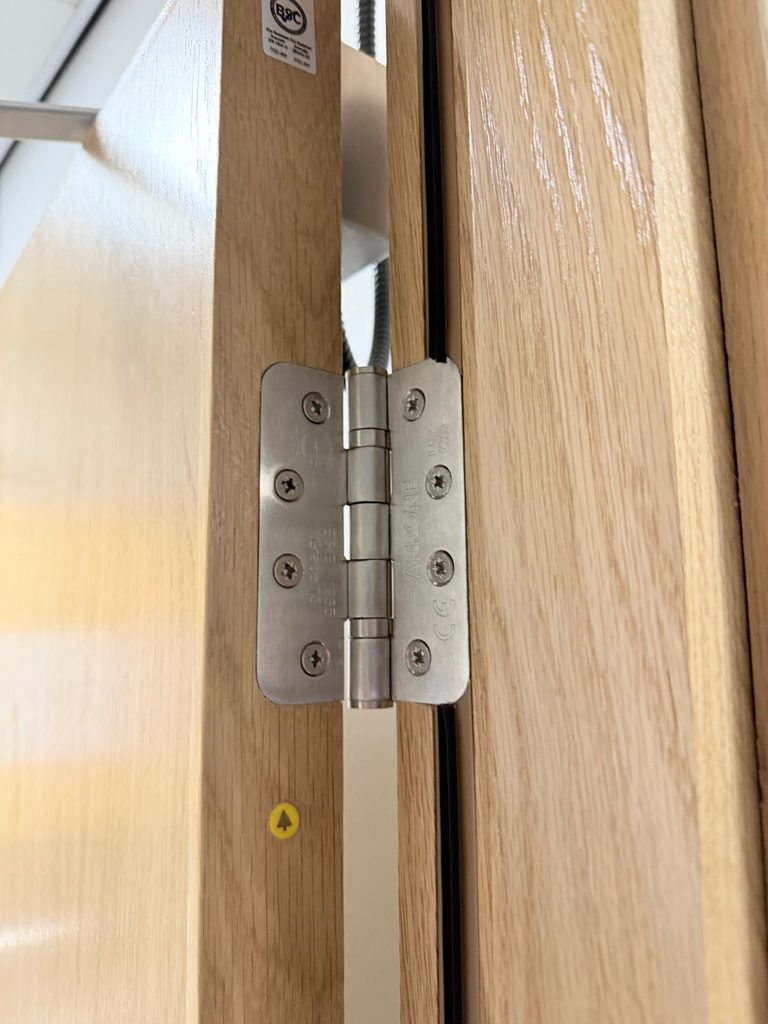
Count the Hinges
Most fire doors need at least three hinges, while heavier doors may need more.
If your flat entrance door only has two hinges, that should immediately raise questions.
Check the screws as well. Each hinge should have all of its screws present and secure. Missing or loose screws may look like a small maintenance issue, but they can allow the door to drop over time.
Once the leaf drops, the gaps can change and the latch may stop engaging correctly.
Check the Gaps Around the Door
Look at the space between the door leaf and frame.
The gaps should remain reasonably even around the top and sides. Around 3mm is typical and is roughly comparable to the thickness of a £1 coin.
Uneven gaps often reveal a problem with the way the door hangs. For example, if the gap narrows at the top of the hinge side but becomes wider further down, the door may have started to drop.
Very large gaps can also reduce the effectiveness of the intumescent seals during a fire.
The threshold gap underneath the door requires more careful assessment because the acceptable measurement depends on the doorset and its test evidence, particularly where smoke control forms part of the requirement.

Look at the Door’s Thickness and Construction
A typical FD30 fire door leaf measures around 44mm thick and usually feels noticeably heavier than an ordinary internal door because it contains a solid core.
A standard hollow internal door often feels much lighter and thinner.
This simple comparison can help you spot an obvious problem, but do not use weight or thickness as proof of certification. A heavy solid timber door can still lack fire certification.
Think of this check as another clue rather than a final answer.
Understand the Fire Door Rating
Fire door ratings tell you how long the door resisted fire during testing.
An FD30 door achieved at least 30 minutes of fire resistance during its test. An FD60 door achieved at least 60 minutes.
The letter S, as in FD30S, means the doorset also includes protection against cold smoke.
Most flat entrance doors in blocks of flats commonly require FD30S performance, although the building’s fire strategy or fire risk assessment may call for a higher standard in some situations.
Ratings such as FD90 and FD120 also exist, but they generally appear in more specialised buildings and higher-risk environments rather than ordinary residential flats.
No Label Does Not Automatically Mean the Door Has Failed
Older flats often have entrance doors with no certification label, plug or paperwork.
That does not automatically mean the door offers no fire resistance.
Professionals often describe these as nominal fire doors. Their construction may provide a degree of fire resistance even though nobody holds modern certification or test evidence for them.
The problem comes down to proof.
Without certification, you cannot confirm the door’s performance simply by looking at it. A competent assessor needs to consider the construction, condition, seals, hardware, building layout and fire strategy before deciding whether the door remains acceptable.
If your block still has older original doors and nobody has assessed them recently, ask your managing agent or freeholder what the latest fire risk assessment says about them.
Watch for Alterations
Even a certified fire door can lose its expected performance after someone alters it.
Look for anything that someone may have added or changed over the years, including:
- Cat flaps
- Replacement letterplates
- Additional locks
- Spy holes
- Decorative glazing
- Removed or changed closers
- Heavily painted seals
Any component cut into or fitted onto a fire door needs to remain compatible with the tested doorset.
This is particularly important if you bought a flat where a previous owner made changes without documentation.
When Should You Get a Professional Opinion?
Your own checks can reveal obvious warning signs, but they cannot confirm everything.
Consider arranging a professional assessment if you cannot find certification evidence, nobody knows the door’s history, the door has undergone alterations, the gaps look uneven, the closer does not work properly or you plan to buy the flat and want certainty before committing.
You should also ask questions if your block sits above 11 metres and the managing agent cannot provide records for the required flat entrance door checks.
A professional fire door survey goes beyond a visual check. An inspector can measure the gaps, assess the components, review certification evidence and document exactly where the door stands.
That gives you something much more useful than a guess, particularly if repair costs, replacement responsibility or leaseholder liability become part of the conversation.
Frequently Asked Questions
Where can I find the label on a fire door?
Check the top edge and hinge edge of the door leaf first. Manufacturers commonly place certification labels or plugs in these areas because they remain hidden during normal use. A certified doorset may also carry a separate label on the frame.
Can a door still be a fire door without a label?
Possibly. Older doors may provide fire resistance based on their construction even if no certification exists. Professionals often call these nominal fire doors. A competent assessor should decide whether the door remains suitable for the particular building.
How thick should a fire door be?
An FD30 door leaf commonly measures around 44mm thick, while higher-rated doors may be thicker. However, thickness alone cannot confirm certification.
Does my flat entrance fire door need a self-closer?
If the door protects a communal escape route, it needs to close and latch reliably without someone manually shutting it. A defective or disconnected closer can undermine the door’s fire protection.
Can painting a fire door cause problems?
Yes. Heavy paint can clog or damage intumescent and smoke seals, and repeated layers can affect the clearances around the door. Inspectors regularly find this problem in older buildings.
Not Sure If Your Front Door Is a Certified Fire Door?
At CFP Carpentry & Fire Prevention, we inspect flat entrance doors for leaseholders, landlords, freeholders and managing agents. We can check your door, document any defects and explain clearly whether it needs adjustment, remedial work or replacement.
We provide fire door surveys and inspections, FD30 and FD60 certified doorset installation, flat entrance door replacement programmes, remedial works and fire stopping. We work across Bournemouth, Southampton, Poole, Exeter and Plymouth in the South and South West; London, Guildford, Slough and Croydon across London and the South East; and Bristol, Swindon and Oxford across the Midlands and wider areas.
If you want a clear answer about your flat entrance door rather than relying on appearances, get in touch to arrange a professional fire door survey.