

Inspect a hundred fire doors in a British building and you will fail most of them. That sounds alarming until you look at what actually fails. The same handful of defects accounts for the overwhelming majority of failures. Almost all of them arise after installation rather than during it. A joiner can correct most of them in under an hour.
Knowing the pattern changes how you manage a building. You stop treating a failed inspection as a crisis and start treating it as a worklist. In this guide we will explain the defects our inspectors record most often. We cover what each one does to the door’s performance, how serious it is, and what the remedy looks like.
Why the Same Defects Keep Appearing
Fire doors fail in predictable ways because buildings use them thousands of times a year and nobody watches them do it.
A door takes a trolley impact. Someone finds the closer stiff and removes it. Decorators paint the seals. A contractor drills through the leaf for a cable. Carpet fitters raise the floor level, and nobody checks the threshold gap afterwards. Each act seems minor in isolation, and each one removes part of what the fire test measured.
BS 8214:2026, which replaced the 2016 edition in March 2026, frames this clearly. The standard treats the doorset as a coordinated system and asks what evidence supports its performance in the condition it is in now. Every defect below chips away at that evidence.
Excessive Gaps Around the Leaf
This defect tops almost every survey we produce.
Head and jamb gaps should measure between 2mm and 4mm. Threshold gaps run larger, typically up to 8mm to 10mm, but tighten considerably where the door needs to control smoke. A gap beyond tolerance lets smoke pass before the intumescent material has any heat to react to, and a gap that is too tight stops the door closing and latching reliably.
Gaps drift for ordinary reasons. Timber moves with humidity, hinges wear and drop the leaf, buildings settle, and installers sometimes cut the door to fit a crooked opening. Floor coverings raise the threshold without anyone recalculating the gap.
The remedy. A new hardwood lipping, machined back to the correct tolerance, corrects most oversized gaps where the manufacturer’s scope permits it. Hinge adjustment or replacement corrects a dropped leaf. Neither requires a new door.


Missing, Damaged or Painted Seals
Intumescent strips and smoke seals fail in three ways, and all three appear constantly.
Seals go missing entirely, usually after someone replaced a leaf without transferring them. Seals split, shrink or lift out of their grooves with age and door movement. And decorators paint over them, which is the most common of the three and the least likely to get noticed, because a painted seal looks perfectly healthy.
Paint matters because intumescent material has to expand freely to seal the gap. A coat of emulsion restricts it. Smoke seals suffer worse, since a painted brush or fin seal stiffens and stops making contact with the frame.
The remedy. Seals replace as components, provided the replacement matches the door’s tested specification in material, dimension and position. Our team handled exactly this at a Bournemouth property where a drop-down seal needed replacing.

Closer Faults and Removals
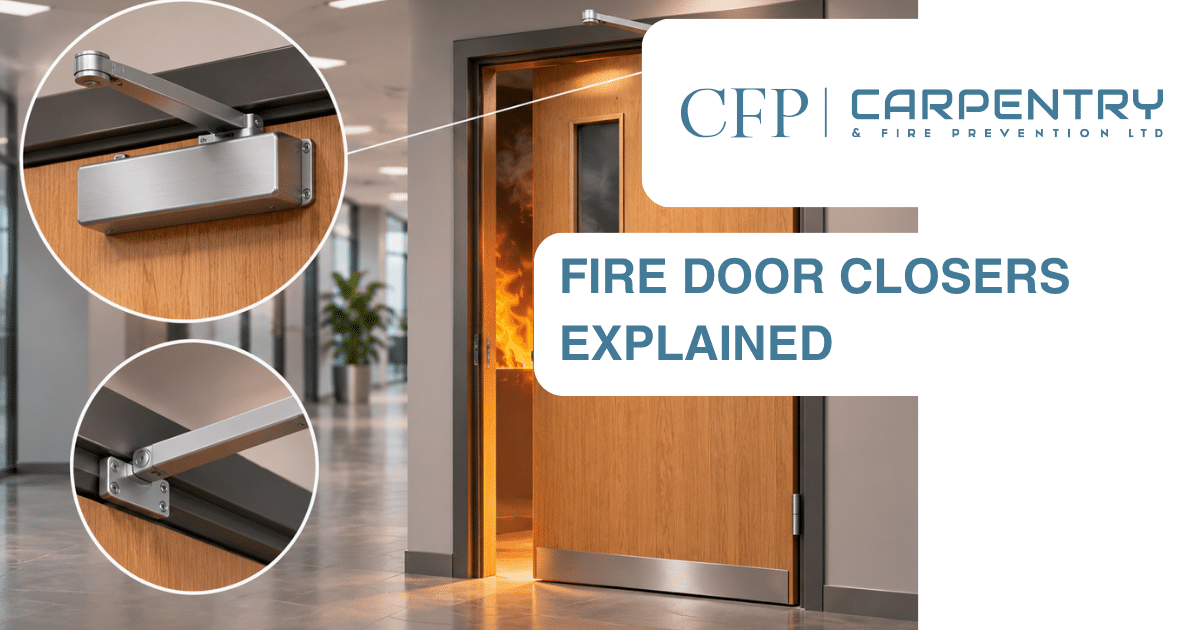
A fire door standing open protects nothing, so closers carry disproportionate weight in any inspection.
Inspectors find closers removed outright, closers that stall before the latch engages, and closers leaking hydraulic fluid. They also record bent or damaged arms, loose fixings, and closers set to the wrong power size. Fire doors need closers capable of power size 3 or above under BS EN 1154, and a closer that feels impossibly heavy usually carries the wrong size rather than a fault.
The test matters as much as the hardware. An inspector opens the door a very small amount, not to ninety degrees, and confirms it closes fully and latches every time. Plenty of closers manage the wide swing and fail the last few degrees, which is where the seals actually meet.
The remedy. Adjustment corrects a slamming or stalling door in most cases. Replacement with a correctly specified device corrects the rest. We adjusted doors on exactly this basis at Dominique in London.
Doors That Do Not Latch
A closer gets a door to the frame. A latch holds it there against the pressure a fire generates.
Latches fail when the keep moves out of alignment, when someone fits the wrong latch, or when the plate wears. They also fail when a resident tapes or wedges the latch to stop it catching. A door resting against its frame without engaging the latch will not stay shut once a fire starts pushing.
The remedy. Realign the keep, replace worn components, and where a resident has defeated the latch deliberately, address the reason rather than just the tape.
Unauthorised Holes and Alterations
This group causes the most expensive outcomes.
Cat flaps, letterplates fitted without certified intumescent protection, vision panels cut in after installation, holes drilled for cables and alarm wiring, and oversized apertures all breach the leaf. So does over-trimming, where an installer cut the door down beyond the manufacturer’s allowance to fit an opening.
Some of these accept certified repair kits. Many do not, and the door needs replacing. We replaced an FD30S ply flush door in Bournemouth where damage had gone beyond the point any repair could recover.
The remedy. Check the manufacturer’s repair scope first. Where no certified repair exists, replace the leaf and record why.
Hinge Defects
Fire doors need a minimum of three hinges, graded to BS EN 1935 and marked for fire use. Two hinges let a heavy leaf twist under load, which pulls the seals away from the frame.
Inspectors find doors hung on two hinges, hinges with missing screws, and brass or aluminium hinges on fire doors. They also find mixed hinge types on one leaf. Intumescent pads go missing where the specification called for them. Screws matter more than they sound: a hinge fixed with three of its four screws no longer carries the load it was graded for.
The remedy. Fit the correct number of correctly graded hinges, with every screw, and add intumescent pads where the specification requires them.


Damaged Frames and Poor Structural Interfaces
Surveys concentrate on leaves and miss frames, which is a mistake.
The gap between the frame and the surrounding structure has to be sealed correctly, and BS 8214:2026 strengthened its guidance on exactly this interface in Section 9.4. Inspectors find frames packed with expanding foam where the tested detail called for something else. They also find voids behind the architrave, split or loose frames, and frames fixed with too few fixings.
The remedy. Open up, seal correctly to the tested detail, and make good. This is remedial work rather than replacement in almost every case.
Missing Certification Evidence
Not strictly a physical defect, but it appears on more schedules than anything except gaps.
A door with no legible label or plug, no documentation and no traceable manufacturer leaves you unable to prove anything about it. A missing label does not automatically mean the door has failed, and plenty of older doors perform perfectly well. But you cannot evidence that, and you cannot specify a repair against a specification you do not know.
The remedy. Where the door is otherwise sound, a competent inspector may be able to assess it and document a position. Where they cannot, replacement buys you evidence as well as a door.
How Serious Is Each Defect?
Not every failure carries the same weight, and treating them equally wastes money and attention.
Deal with anything that stops a door closing and latching first, because that defect removes the door’s function entirely. A removed closer on a flat entrance door, or a stairwell door that will not latch, compromises the escape route today.
Deal with breaches of the leaf next, then seals, then gaps, then cosmetic damage. Across a survey of 140 communal doors at 8 Finsbury Circus, that ordering is what turns a long defect schedule into a programme somebody can actually deliver.
A fire door survey should give you this prioritisation as standard. A survey that lists defects without ranking them has done half the job.
Frequently Asked Questions
What is the most common fire door defect?
Excessive gaps around the leaf, followed closely by seal defects and closer faults. Gaps beyond the 2mm to 4mm range at the head and jambs appear on the majority of surveys. Most of them correct with a new lipping rather than a new door.
Does painting a fire door cause it to fail?
Painting the leaf is usually fine. Painting the intumescent strips and smoke seals is not, because paint restricts the expansion the seals rely on. Inspectors record painted seals constantly, and the defect is easy to miss because the seal still looks intact.
How many hinges does a fire door need?
At least three, graded to BS EN 1935 and marked for fire door use. Two hinges allow a heavy leaf to twist, which pulls the seals away from the frame and opens the gap along the closing edge.
Can a fire door fail inspection for a missing label?
A missing label on its own does not condemn the door, but it leaves you without evidence of the specification. Where a competent inspector cannot establish what the doorset is, replacement is often the only route to a documented position.
How often should we check for these defects?
Commercial buildings and blocks of flats both need routine checks between detailed inspections. Regulation 10 of the Fire Safety (England) Regulations 2022 applies where the top storey sits above 11 metres. It requires quarterly checks of communal fire doors, and annual best endeavours checks of flat entrance doors.
Need Your Fire Doors Assessed Properly?
At CFP Carpentry & Fire Prevention, we inspect fire doors and produce door-by-door defect schedules that rank every finding by risk and recommend a repair or a replacement with a reason. We then carry out the remedial work. We support freeholders, managing agents, housing associations, residents’ management companies and commercial building owners.
Get in touch today to arrange a fire door survey for your building.