

An FD30 fire door is a doorset that resists fire for at least 30 minutes in a fire test. It is also the most common fire door rating in the UK. You will find FD30 doors on flat entrances, communal corridors, stairwells, HMO bedrooms and the escape routes of most commercial buildings.
Because they are everywhere, FD30 doors are also the ones people misunderstand most often. For example, a door can look exactly like an FD30, match the thickness, and still have no rating at all. Even a genuine FD30 can lose its performance through everyday wear and well-meant repairs.
In this guide we explain what FD30 and FD30S mean and how testing works. We also cover where you need these doors, how to spot a genuine one, and what keeps it working once it is in place.


What an FD30 Fire Door Rating Means
FD stands for fire door. The 30 is the number of minutes the complete doorset stopped flames and hot gases getting through or around it in a standard furnace test.
However, thirty minutes is not a promise about a real fire. Instead, it is a way to compare doors under the same controlled conditions. In practice, it gives people time to escape and protects the route they use, as long as the door is shut, latched and in good condition.
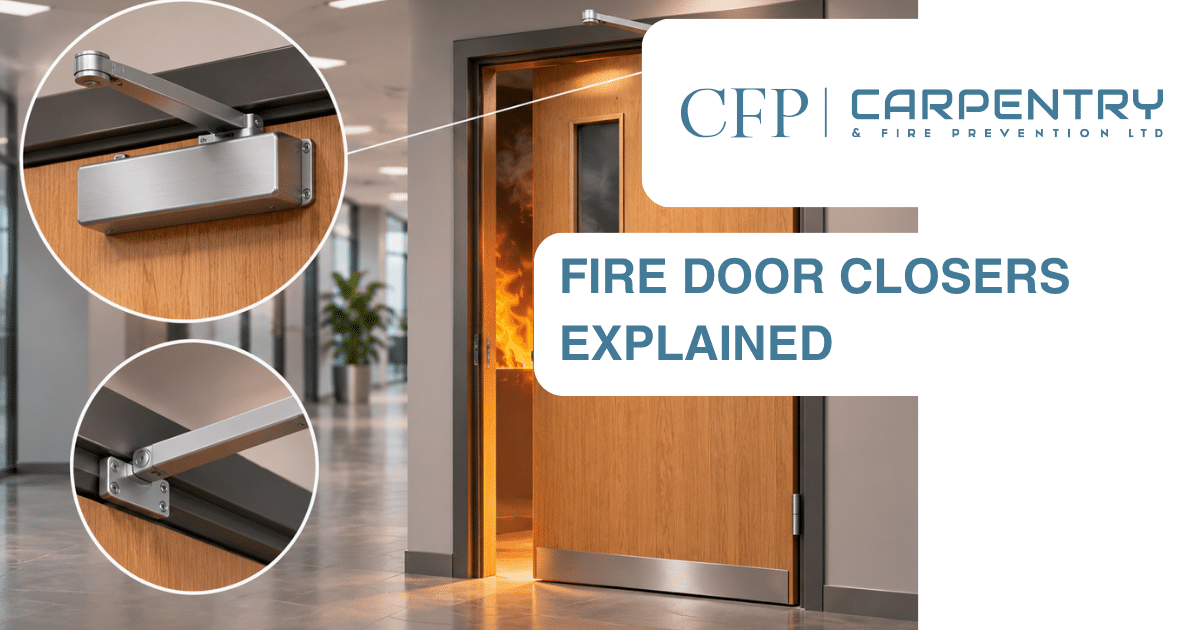
The rating also belongs to the tested assembly as a whole. That means the leaf, frame, intumescent seals, hinges, latch, closer, glazing and fixings all count. So if you fit hardware from outside the test evidence, or hang a certified leaf in an unrated frame, you no longer have a reliable FD30.
Our guide to how a fire door works explains what each part does.
FD30 vs FD30S
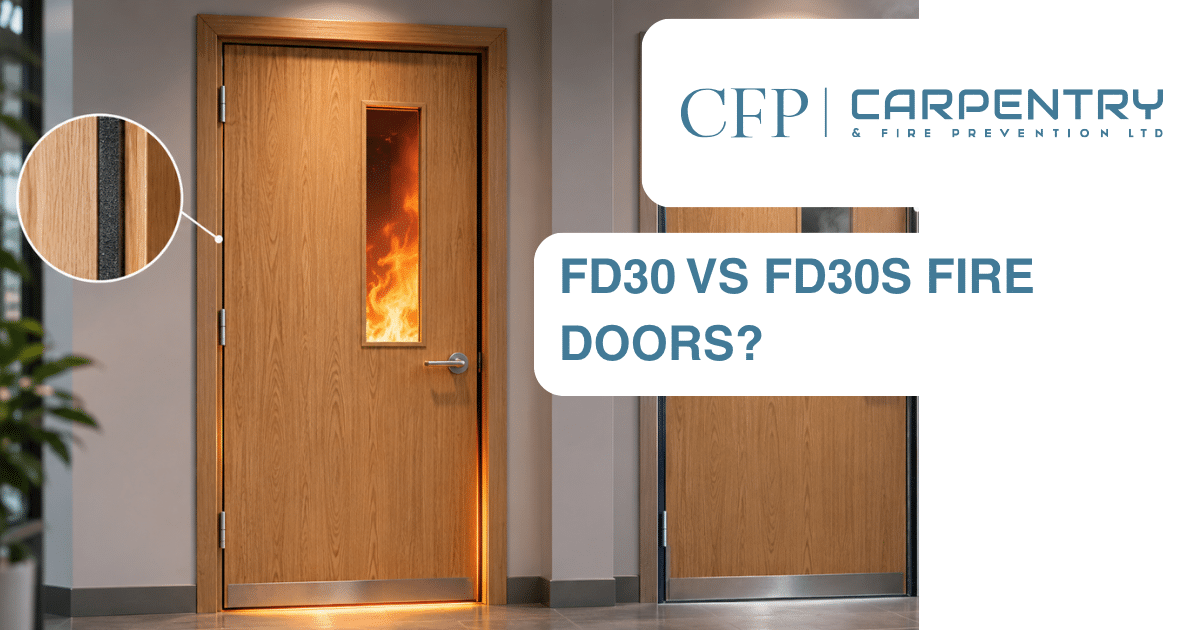
FD30S adds smoke control. The S means the door has smoke seals as well, usually brush or blade seals alongside the intumescent strip, and the maker has tested it for cold smoke leakage.
This difference matters more than many people realise. Intumescent seals only react to heat, while smoke arrives first. In fact, cold smoke rather than flame is what blocks most escape routes. As a result, a door without smoke seals can hold back fire for thirty minutes but still let smoke into the corridor from the start.
For this reason, most flat entrance doors and doors onto protected corridors and stairs need the S. You may also see the European version, E30Sa, on newer doors and plans.
Our article on FD30 and FD60 specifications compares the two ratings side by side.
[Image: close-up of a combined intumescent and brush smoke seal in a door frame] Alt text: A combined intumescent and brush smoke seal fitted in the frame of an FD30S fire door.
How Fire Testing Works for FD30 Doors
Test labs always test fire doors as complete doorsets in a furnace. The national test is BS 476-22, which gives the FD30 rating. The European test is BS EN 1634-1, with results under BS EN 13501-2, and it gives the E30 rating. Smoke testing then follows BS 476-31.1 or BS EN 1634-3.
Changes to Approved Document B remove the BS 476 fire resistance references from 2 September 2029, subject to transitional rules. After that, new projects under the guidance will use the European ratings. This does not make existing FD30 doors non-compliant. Even so, you will see E30 and E30Sa more and more in new plans.
Where You Need FD30 Doors
For new building work, Approved Document B sets out where you need fire doors and what rating they should have. For existing buildings, however, the fire risk assessment decides. It works within the Regulatory Reform (Fire Safety) Order 2005 and, for houses in multiple occupation, local housing standards too.
For example, you will often find FD30 or FD30S doors in these places:
- Flat entrance doors that open onto communal corridors or stairs
- Doors onto protected stairwells and protected corridors
- Cross-corridor doors that divide long escape routes
- Bedroom and kitchen doors in many HMOs
- The door between an integral garage and a house
- Doors to risers, cupboards and stores off escape routes
Flat entrance doors raise the most questions, so our guide on whether a flat entrance door needs to be a fire door covers them in detail. Similarly, our guide to essential fire safety measures for HMOs sets out where licensing conditions usually call for them.
How to Tell a Genuine FD30 Fire Door
Most people check the thickness first, but it proves very little. Timber FD30 leaves are usually around 44mm thick. However, plenty of ordinary doors are 44mm too.
Instead, the proof that counts is certification. A genuine FD30 door will usually carry a label on the top or hinge edge of the leaf, or a coloured plug set into it. That label links to a third-party certification scheme, which in turn leads back to the maker’s test evidence and fitting instructions.
You should also look for intumescent seals in the leaf edge or frame, three hinges on a standard leaf, a working self-closer and the right signs. Still, those are signs rather than proof, because a door can have all of them and still lack certification. Our article on how to tell if a flat’s front door is a certified fire door explains how to check. In addition, our guide for buyers checking a flat’s front door covers what to ask before you exchange.
[Image: hand pointing to a certification label on the top edge of a fire door leaf] Alt text: A certification label on the top edge of an FD30 fire door leaf, used to confirm the door’s fire rating.
Installing an FD30 Fire Door Properly
When an FD30 fire door fails one of our surveys, the cause is usually poor fitting rather than a faulty product.
First, the installer must fix the frame securely into a fire-resisting wall. They then close the gap between frame and wall with a fire stopping product that suits that gap. Next, the leaf needs gaps of around 2mm to 4mm at the head and sides, and the gap at the bottom has to suit the door’s smoke rating. Our guide to fire door gap tolerances explains how to measure them.
All hardware also has to come from the door’s evidence. That includes the hinges, latch, closer, letterplate, spyhole and any vision panel. For instance, a non-rated letterplate or a new hole cut for a lock can undermine the whole door. Professional fire door installation that follows the maker’s instructions and BS 8214:2026 avoids these problems from the start.
A glazed FD30 fire door needs extra care, because the glass, beads and glazing seals all have to match the evidence. For example, we recently fitted a new FD30S glazed fire door at a Bournemouth property. On a larger scale, we also carried out FD30 fire door installation at Chelsea FC’s training ground.
Keeping an FD30 Fire Door Working
Under Article 17 of the Fire Safety Order, the responsible person must keep fire doors in efficient working order and good repair. In addition, the Fire Safety (England) Regulations 2022 add quarterly checks of communal fire doors and annual checks of flat entrance doors in blocks of flats over 11 metres.
An FD30 fire door takes heavy daily use, so it wears. Closers drift out of adjustment, and people paint over or knock out seals. Hinges also loosen, which lets the leaf drop. Water can even write a door off entirely, as we saw in an FD30S ply flush door replacement after a basement leak.
Fortunately, you can fix many faults without replacing the door, as long as the repair stays within what the certification allows. Our fire door remedial page explains what we can fix in place. Meanwhile, our list of common fire door defects shows what inspectors look for.
Frequently Asked Questions
What does FD30 mean?
FD30 means fire door, 30 minutes. The complete doorset kept fire from getting through or around it for at least 30 minutes in a standard fire test.
What is the difference between FD30 and FD30S?
FD30S also has smoke seals, and the maker has tested it for cold smoke leakage. Because of this, most flat entrance doors and doors onto protected escape routes need the S.
How thick is an FD30 fire door?
Timber FD30 leaves are usually around 44mm thick. However, many ordinary internal doors match that thickness, so thickness alone does not prove a rating.
Can I fit an FD30 door myself?
The law does not ban it, but a door only performs as well as its fitting. The frame fixings, gaps, fire stopping and hardware all have to follow the test evidence. A competent installer will also record that the work does.
How often should you check FD30 doors?
It depends on the building and how people use it. In blocks of flats over 11 metres, you must check communal fire doors at least every three months and flat entrance doors at least once a year. Busy commercial buildings often need more frequent checks.
Need FD30 Fire Doors Fitted or Inspected?
At CFP Carpentry & Fire Prevention, we install certified FD30 and FD30S doorsets. We also survey existing doors against their certification and carry out the remedial work that surveys find. We work with landlords, freeholders, managing agents and commercial building owners.
In the South and South West we cover Bournemouth, Christchurch, Poole, Southampton, Portsmouth, Salisbury, Exeter and Plymouth. Across London and the South East we cover London, Reading, Guildford, Slough and Croydon. We also work in Bristol, Swindon and Oxford.
Want to know whether your doors are genuine FD30s? Get in touch to arrange a fire door survey.